
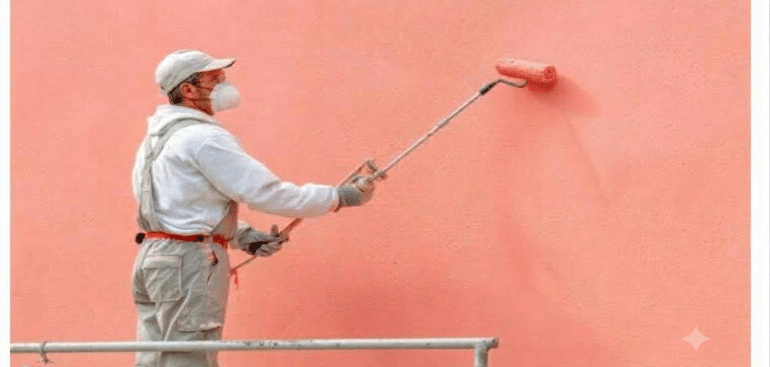
If you are a property owner in Spain, you surely know the effects of weathering on a façade. Powerful UV exposure from months of abundant sunshine, summer heat, coastal saltiness and the occasional heavy downpours; paintwork can chalk and peel long before its time.
Before investing in an exterior wall coating, the question that arises is how long such an intervention last in the local climate would, and if it is cost-effective compared to classic exterior repainting?
The answer largely depends on several key factors. In the following paragraphs, we will present you with the most important aspects that determine a coating’s life expectancy, as well as realistic expectations and ways to prolong the lifespan of your investment.
What Is an Exterior Wall Coating?
An exterior wall coating is a specialist protective finish applied to the exterior surface of a building. Unlike conventional house painting, it is not a thin rigid film but an elastomeric coating that conforms slightly to the movement of the wall, repels water and allows moisture trapped in the masonry to evaporate away.
At No Need to Paint we always apply our coating as a professional multi-stage treatment rather than a quick weekend job. This is an important difference since it is the key to the longevity of the finish.
So, How Long Does It Last?
Ordinary facade paint in a sunny climate usually requires renewal after 5 to 7 years, even on shaded and/or coastal walls.
A conscientiously applied exterior wall coating should significantly extend the intervals between renewed paintings. Our system includes a 15-year guarantee; we have been coating walls for more than 30 years, so you can treat this as the time during which your wall will stay beautiful. Of course, the actual period may vary depending on several factors given below.
The coating lifespan is a probabilistic value; it is calculated considering multiple real cases and shows the time when the paint should still be in good condition in the majority of situations. The main conditions that affect the coating lifespan are the following:
What Affects the Lifespan of an Exterior Wall Coating in Spain?
1. Surface Preparation
This is the most crucial factor and often overlooked by homeowners. The surface to be coated plays a big part in how good or bad the coating will be. Any dirt, algae, loose paint or damaged render left on the surface will cause the bond between the surface and the coating to fail prematurely, regardless of the quality of the coating used.
Our process starts by using power washing and wire brushing to remove any loose dirt and paint. Mould, algae infestation are treated and removed with appropriate biocides and cleaning solutions. Grease or pollution is also carefully removed.
2. Repair of cracks, damaged render etc
Cracks in the render, blown brickwork or pebbledash are ground out and filled with polymer resin. All loose render is replaced. This process is vital to ensure that water does not get trapped behind the coating thus causing a hydraulic lock which will push off the coating.
3. Sun exposure
The Spanish sun is unforgiving. UV radiation breaks down paint molecules causing the paint to yellow and become powdery. A colour stable coating is far more resistant to UV degradation and the flexibility of the binder allows the coating to flex with the building structure during the day and night expansion cycles.
4. Coastal / Humid areas
Salt rich air around coastal regions and high humidity in tropical climates encourages mould and algae growth. A breathable, mould resistant coating will resist these conditions far better than a regular paint by allowing moisture to escape from the surface of the wall.
5. The quality of the finish
We apply the final finish by spraying at high pressure to give a smooth uniform appearance. A suitable primer is applied as needed according to the porosity of the surface or condition of the surface being coated.
How Does It Compare With Repainting?
Over the course of 15 years, a homeowner who uses regular paint can repaint a house two or even three times. It requires considerable effort, time, scaffoldings or other access equipment, material and disruption for each repaint. Although a coating is more expensive at the beginning, the total cost will be lower because of the reduced number of repaints.
Besides, it will not chip, flake or peel, which are the most common reasons why walls have to be repainted.
Can You Make Your Wall Coating Last Longer?
Yes. There are a few simple techniques that may help:
- Checking the walls at least once a year for any new cracks, stains, or damp patches;
- Trying to address any issues as they arise, rather than letting them get out of control;
- Removing any dirt or algae that may be on the wall surfaces;
- Making sure the gutters are clean and water is not running down the walls either;
- And using professional applicators, since the preparation will determine the final result.
Conclusion
So, how long does exterior wall coating last in Spain? When correctly applied to a well-prepared surface, it should last significantly longer than standard paint. Our system comes with a 15-year guarantee and over 30 years of expertise, so your results will depend on the condition of your walls, the local climate and the standard of work performed.
If your walls are cracked, faded or peeling, now is the ideal time to seek expert advice to prevent the issues from worsening
Want to stop repainting? The team at No Need to Paint can assess your property and advise the best solution for your needs. Check out our exterior wall coating service or contact us to book a survey today. You can also request a colour sample from our 16 standard shades, with bespoke colours also available.
Frequently Asked Questions
1. How long does an exterior wall coating last in Spain?
With correct installation, our coating lasts 15 years in Spain as the system guarantees. The life of the coating on your house will depend on the condition of the wall prior to application.
2. Is the Spanish sun damaging to an exterior wall coating?
The strong UV content in the Spanish sun can be very hard on a paint finish but our colour stable and flexible coating polymer is much more resistant to sun damage.
3. Is an exterior wall coating better than painting?
To get a longer lasting result yes, although painting is a cheaper option up front a coating can prove to be more economical in the long run.
4. Will an exterior wall coating be suitable for coastal properties?
Yes, we have a specific mould resistant coating that is breathable and water resistant that is ideal for coastal areas with high humidity, as long as the walls are prepared correctly.
5. Can an exterior wall coating be applied to walls with existing paint or damaged render?
In many cases, yes. Any flaking paint would be removed and cracks filled in before applying the coating but as long as the wall surface is sound it can be coated.
6. How do I know when I need to recoat my walls?
If you notice fading, white dusty patches on your walls, cracks in the render or coating, flaking paint, damp patches or mould and algae growing then it is probably time to recoat.
7. What colours are available?
We have 16 standard colours and a bespoke colour matching service, as colours can vary on screen we recommend you ask us for a swatch before ordering.